
Field notes
Meetings are bad for business
Put a fully-loaded cost on the room, and most recurring meetings would not survive the math.
Meetings feel free, so nobody prices them. Put a fully-loaded hourly cost on the room - the exec, the VP, the technical lead who should be shipping, the marketers - times a few meetings a week, times the year, and one company can burn six figures on recurring calls that decide nothing. The model comes first, then the fix.
On this page
Meetings are the largest line item most companies never put on a budget. They feel free, so nobody counts them, and because nobody counts them they multiply until the calendar is full and the work has nowhere to go.
This goes beyond a busy calendar. It is an operations problem with a number attached, and once you see the number it is hard to unsee.
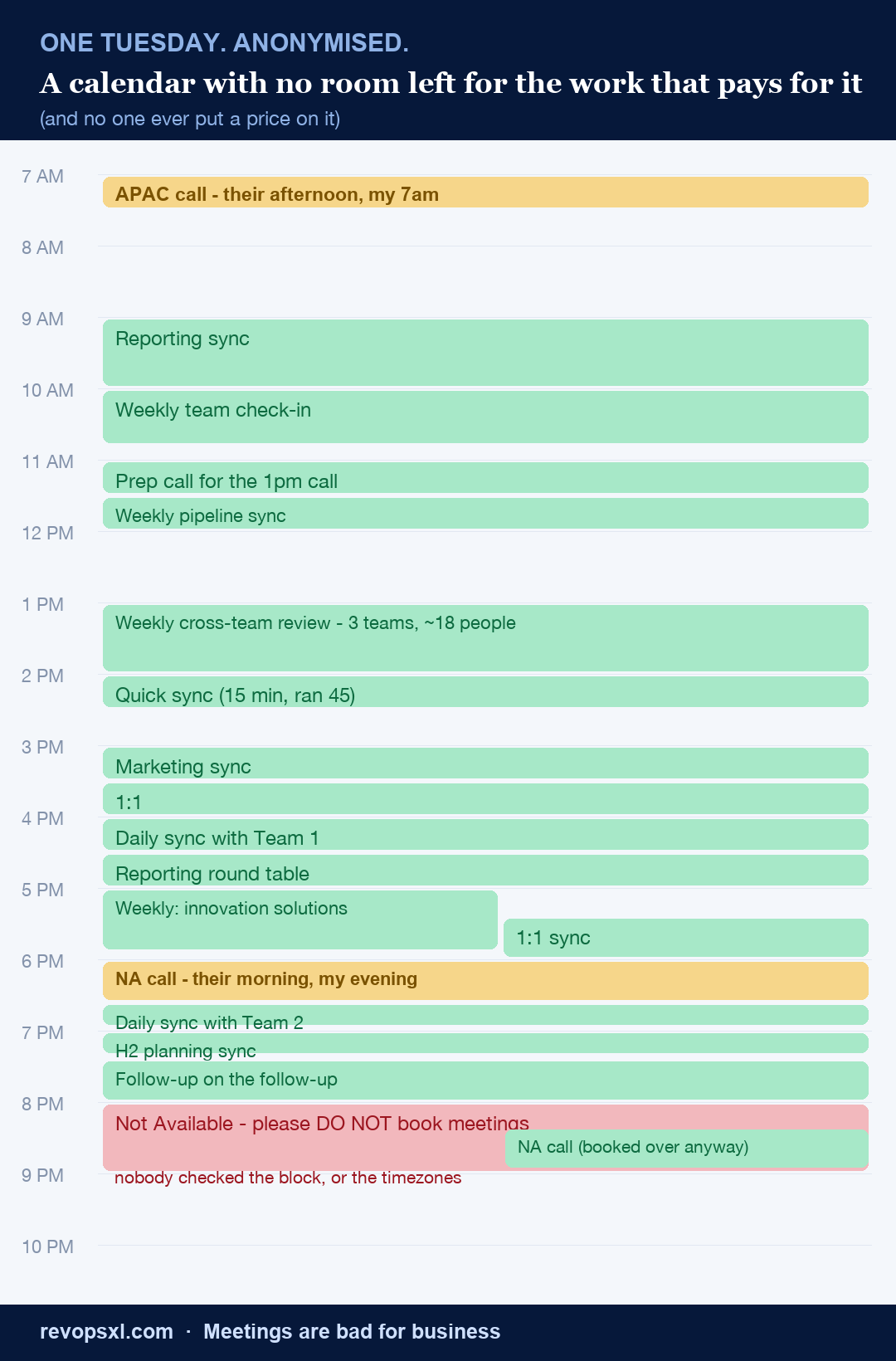
Put a price on the room
Every company knows its software spend to the dollar. Almost none can tell you what its meetings cost. That is odd, because for most teams the meetings are the bigger number. A meeting feels free. Nobody sends an invoice for an hour of everyone’s attention. But every person in that room is paid, and at the end of the month the company settles the bill whether the hour produced anything or not.
So price one. Take a single weekly cross-team review, the kind most companies run without thinking. Look at who is on the call, and put a fully-loaded hourly cost on each seat: salary, benefits and overhead, divided by the hours they work.
| Who is actually on the call | Cost / hour |
|---|---|
| C-suite executive | $250 |
| VP of Sales | $150 |
| Sales director | $110 |
| Senior technical lead (consults with customers, ships delivery) | $130 |
| Marketing lead | $80 |
| Marketing associate | $55 |
| RevOps / project lead | $75 |
| Sales rep | $65 |
| One 1-hour session | ≈ $915 |
That is roughly nine hundred dollars for one hour. Hold it every week and you have spent about forty-seven thousand dollars a year on a single recurring meeting. And most companies do not have one of these. They have three, four, five - the sales review, the marketing sync, the delivery stand-up, the leadership cadence. Multiply a nine-hundred-dollar hour by a handful of weekly meetings, by four weeks, by twelve months, and you are comfortably past a hundred and fifty thousand dollars a year, before anyone has prepared for a single one of them or recovered from it.
The most expensive seat on that call is usually the technical lead, not the executive: the person who consults with customers, shapes the projects and ships the delivery. Their hour in a status meeting costs more than their salary; it costs the revenue that hour would have earned, in front of a buyer or inside the work. Price a billable resource at what they bill, not what they are paid, and their real cost in the room is often two or three times the line above, which means the most valuable person on the call is usually the one whose time is wasted most.
The meetings that cost the most are the ones nobody prices
Once you start reading a calendar as a bill, certain line items stand out. These are the ones we flag in almost every audit:
The meeting to prepare for the meeting. A call whose only output is another call. If the prep needs an hour of eight people, the real meeting was never designed; it was outsourced to a warm-up.
The recurring sync that outlived its reason. It solved a real problem once. The problem is gone; the invite renews forever, because cancelling it feels like admitting it was never needed.
The status update that should have been written. Ten people take turns saying what a shared document could have said in two minutes, on their own time, without anyone waiting.
The quick fifteen that runs forty-five. Booked short to feel efficient, it expands to fill the room, and the three tasks each person left to attend it now spill into the evening.
The decision made by a dozen people, which is a decision owned by none. The bigger the room, the more diffuse the accountability, until “we aligned’ slips in for “we decided,” and nothing moves.
The review that is a broadcast in disguise. Decks get presented instead of results discussed, a bad quarter slides past without the question it deserves, and attendance stands in for progress. A room built for being seen agreeing cannot make a hard call, which is usually the point.
The call booked across timezones without a glance at where people live. Someone’s 7am, someone’s dinner, someone’s only two focused hours of the day. That is a cost too, paid in attention and goodwill, and it never shows up on the invoice.
The bill you cannot see
The money is the visible cost, and the invisible one is larger. Every hour in an unnecessary meeting is an hour not spent on the work that produces revenue, and knowledge work does not survive being chopped into fragments. The build, the fix, the analysis, the thinking - they need two or three uninterrupted hours, and a calendar of back-to-backs never offers two of anything.
So the real work migrates to the edges: early mornings, late evenings, weekends. The team looks fully utilised and is running on overtime to do the job the meetings were supposedly about. Output stays flat while burnout climbs.
And there is a second hidden bill: the decisions that never get made because everyone was aligning instead of deciding. A forecast nobody trusts, a handoff nobody owns, a strategy that has stalled and cannot be discussed in the one room where everyone is present. Meetings are supposed to be where decisions happen. In most companies they are where decisions go to be admired.
What a meeting has to earn
None of this is an argument against meetings. The right meeting is one of the most valuable hours a company can spend: a live disagreement that needs resolving, a genuine problem that needs several minds at once, a decision that has to be made in the room. That meeting is real, and it is rare - maybe one in ten of the ones currently on your calendar.
The fix is to make every meeting earn its place against the thing it displaces. In practice that means a short list of operational rules:
Give every meeting a decision it exists to make; if there is no decision, there is no meeting. Default to written, because a document read on someone’s own schedule beats a call half-heard at double speed. Price your recurring meetings the way we just did and audit them once a quarter: what does this produce, and would we miss it if it vanished? Protect blocks of focused work as if they were revenue, because they are. And check what time it is where the other person lives before you drop a call on their calendar. This is the same discipline that turns a scattered week into a real operating cadence: fewer meetings, each with an owner and an output.
Underneath all of it is an ownership problem. Meetings multiply fastest where nobody owns the shape of the system, because a new invite always feels safer than a hard decision. Put a price on the room, and the hard decision starts to look like the cheap option. Cancel the meetings that cannot justify their cost, and a surprising amount of the number you were missing lands straight back in the business, as time, as focus, and as work that finally gets done.
Common questions
How much do internal meetings actually cost a business?
More than almost anyone measures. Put a fully-loaded hourly cost on each attendee (salary, benefits and overhead, divided by hours worked), sum the room, and multiply by the duration and the frequency. A single weekly cross-team meeting with a few senior people on it runs into tens of thousands of dollars a year; a handful of them runs comfortably into six figures, before any prep or recovery time is counted.
How do you calculate the cost of a meeting?
Fully-loaded hourly cost per attendee, summed across everyone on the call, times the length of the meeting. For billable or delivery staff, use their opportunity cost - what their hour would have earned in front of a customer or inside the work - not their salary line, because that is the revenue the meeting is actually spending.
How do you reduce internal meetings?
Give every meeting a single decision it exists to make, default status updates to writing, price and audit recurring meetings each quarter, protect blocks of focused work, and check timezones before booking. Cancel any recurring meeting that cannot say what it produces and would not be missed.
Are all meetings a waste of time?
No. A meeting is worth it when there is a live disagreement, a real problem that needs several people at once, or a decision that has to be made in the room. That meeting is valuable and rare. The waste is the default: the unpriced recurring calls, the status updates that should be documents, and the reviews that broadcast instead of decide.