
Senior ownership of your HubSpot, for the days a month you actually need it.
Your HubSpot ran fine for a year or two, then it drifted. Fields multiplied and workflows started working against each other, and the numbers in your board deck stopped matching the CRM. A fractional HubSpot expert takes ownership of the whole system, redesigns the parts that stopped making sense, and keeps it that way on a rolling monthly basis.



The role
What a fractional HubSpot expert owns
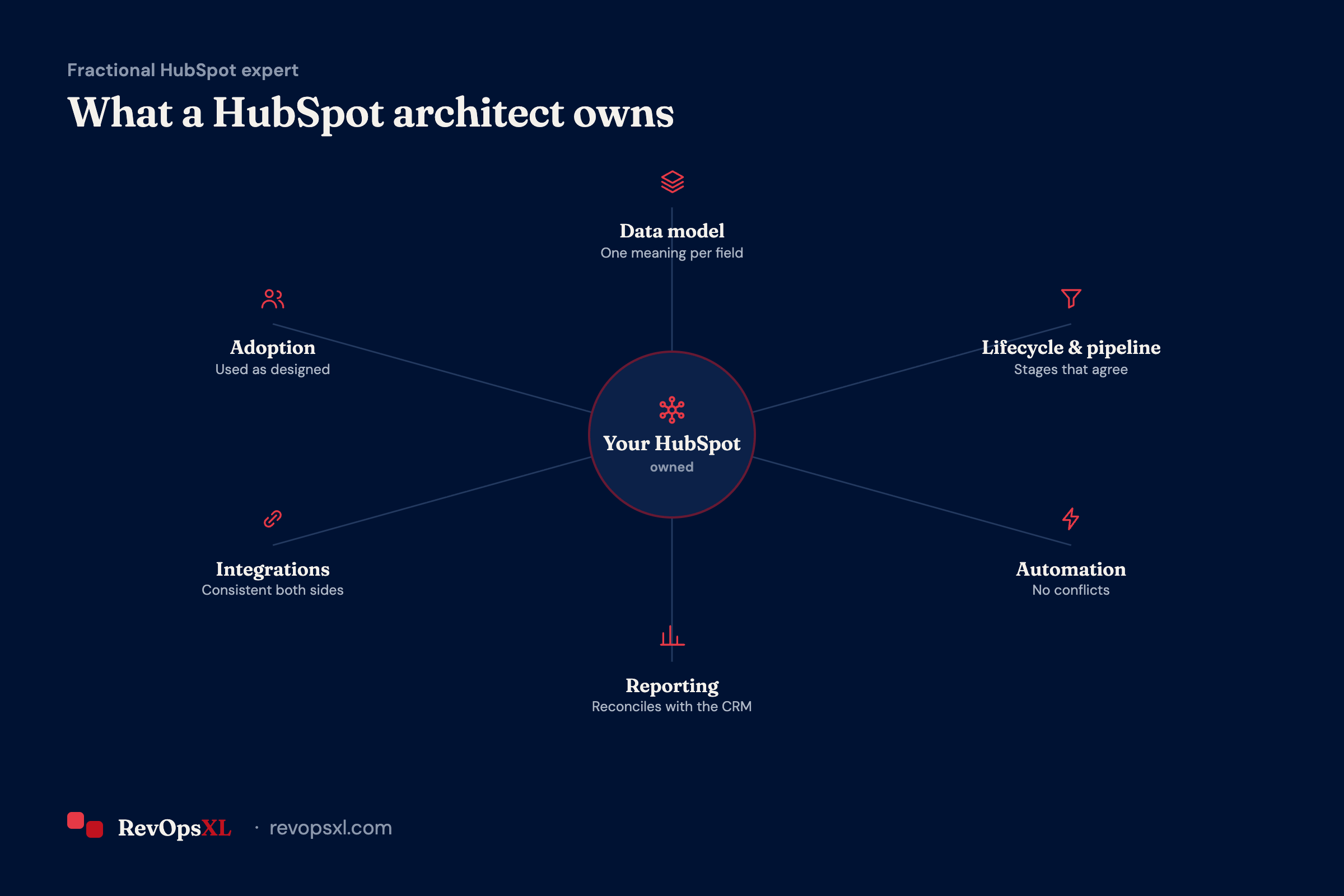
A junior admin closes the requests in their queue. A HubSpot architect owns the portal as a system: the data model, lifecycle and pipeline, automation, reporting, integrations, and whether your team actually uses it. The map shows the six areas we take responsibility for.
Ask about a fractional HubSpot expert
Architect vs admin
Senior ownership, not ticket-taking
A junior admin makes the change you describe. An architect decides what the change should be, and whether a new field belongs in the data model at all. The result is a portal that gets simpler as it grows, instead of one that piles up fields nobody remembers creating.
If you already have a strong admin, we work above them, setting the standards and letting them execute. If you have no one, we cover both.
Sound familiar?
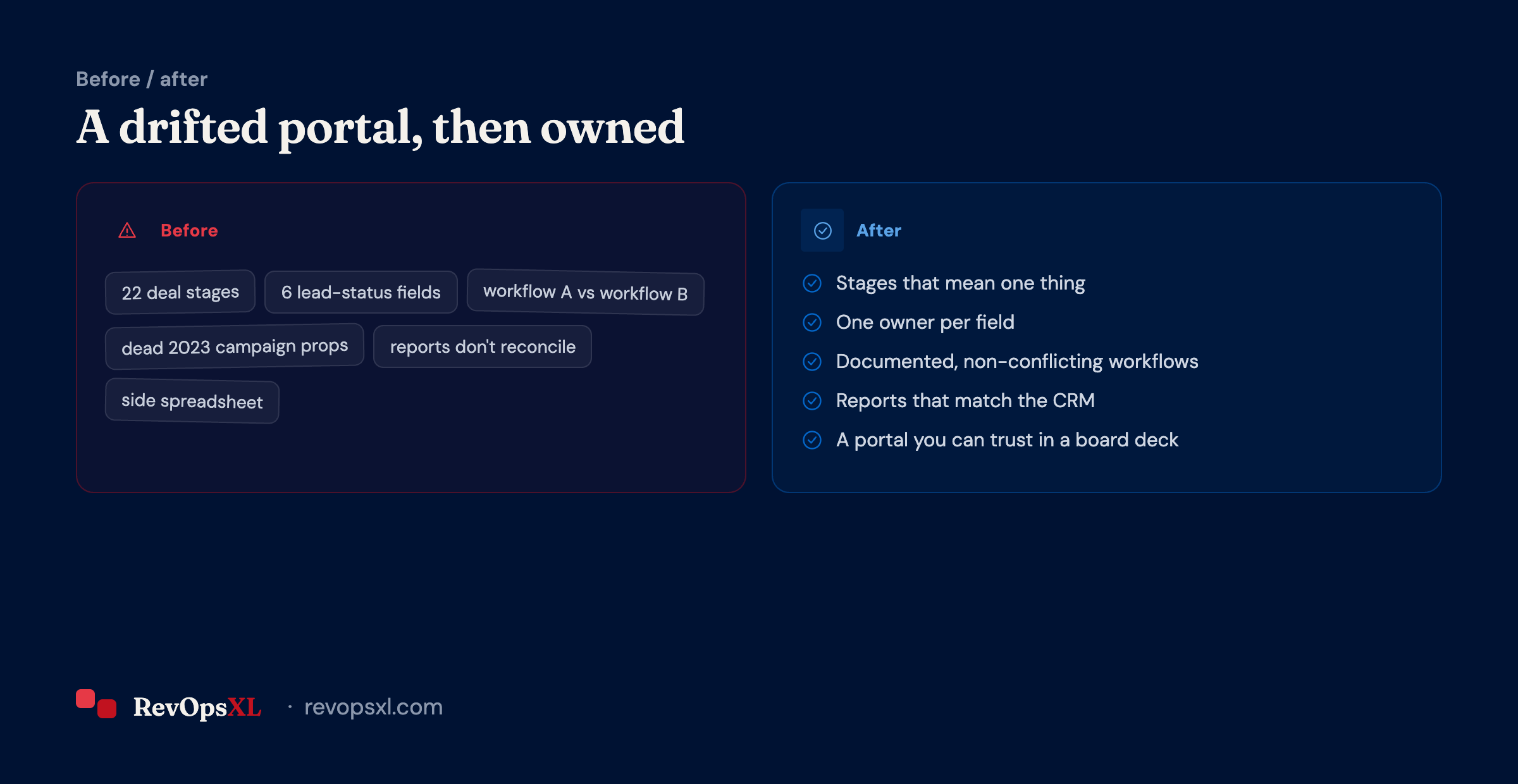
The portal we usually meet
Twenty-two deal stages across three pipelines that mean different things depending on who you ask. Six lead-status properties, four left over from a campaign that ended in 2023. One workflow that reassigns deal owners, and a second that reverses it an hour later. It is what a busy team ends up with when no one senior has time to own the tooling. Our job is to own it.

Your options
Weighed against the alternatives
- An agency runs campaigns, with portal support bundled in and handed to a rotating pool. An architect is one senior owner focused on the operating system itself.
- A full-time hire fits when you have enough steady-state work and the budget for a loaded salary. The portal usually needs senior attention a few days a month, not five days a week.
- Doing nothing still has a running cost: sales on stale data, forecasts you have to caveat, spend attributed to the wrong source.
How it works
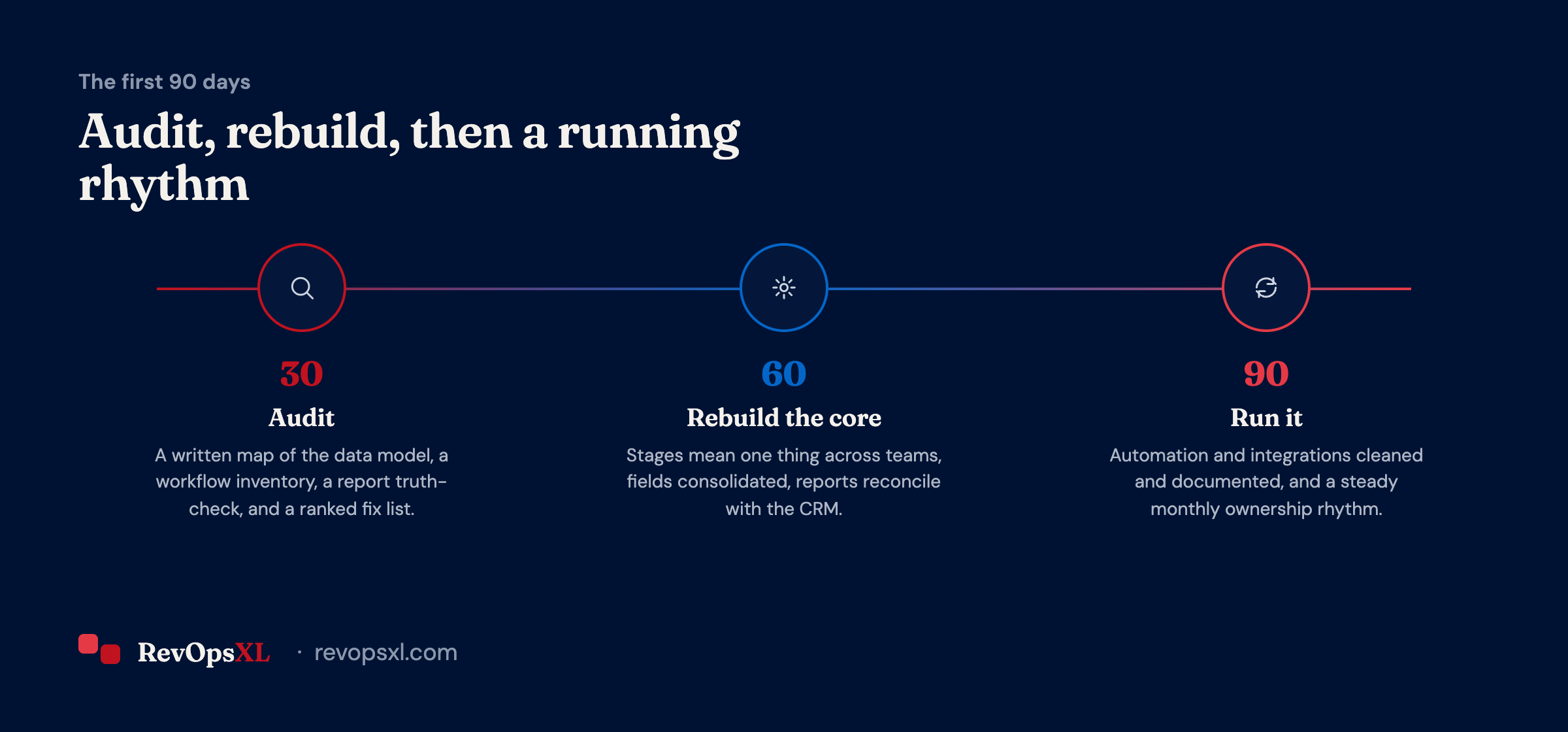
Audit first, then rebuild and run
- Audit. A written map of the data model, a workflow inventory, and a ranked fix list. Yours to keep whether or not we continue.
- Design and build. We rebuild the core: stages, property consolidation, workflow cleanup, and reports leadership can trust.
- Run. Ongoing ownership on a set number of days a month, rolling with no long lock-in.

Fit
Who this is for, and who it is not
A good fit
- No one senior owns your HubSpot.
- The portal has drifted and reporting is not trusted.
- You want senior ownership without a full-time hire.
- You are moving onto HubSpot, or off it.
Probably not
- You want campaigns and content run.
- You need someone on site every day.
- You want the cheapest pair of hands for tickets.
- You want the setup left exactly as it is.
Beyond HubSpot
An honest note on Salesforce and Pipedrive
HubSpot is where we go deepest and where most of this work happens. We also work in Salesforce and Pipedrive, so a mixed setup, or a move between systems, gets planned on both sides together. If your real problem turns out to be a Salesforce one wearing a HubSpot costume, we will tell you plainly rather than bill you to rearrange the wrong system. Weighing the two? We compared them in HubSpot or Salesforce.
Questions
Fractional HubSpot expert, answered.
What does a fractional HubSpot expert do?
A fractional HubSpot expert takes senior ownership of your HubSpot portal on a part-time, ongoing basis. That means designing and maintaining the data model, lifecycle and pipeline stages, automation, reporting, and integrations, so the system stays accurate as your business changes. It is broader than a support admin who only closes tickets, because the expert is accountable for how the whole portal fits together over time.
Do you do fractional HubSpot admin or administrator work?
Yes. The day-to-day administration is part of it: users and permissions, properties, workflows, data cleanup, the upkeep a healthy portal needs. The difference is who does it. Instead of a junior HubSpot administrator handling only the tickets, you get a senior architect who does the same upkeep and fixes the reasons it keeps piling up. Same maintenance, run by someone who can see the whole system.
Fractional HubSpot expert vs a HubSpot agency?
An agency is usually organised around running marketing campaigns, with portal support bundled into the retainer and often handled by a rotating team. A fractional HubSpot expert is one dedicated senior person whose whole focus is the operating system: the architecture, data quality, and reporting. If you need campaigns run, an agency fits. If you need the underlying HubSpot system owned and kept sound, a fractional expert fits.
How much does a fractional HubSpot expert cost?
Pricing is based on the number of days per month you need, on a rolling monthly basis with no long lock-in. It sits well below the loaded salary of a full-time senior HubSpot hire, because you are paying for the fraction of time the work actually requires. It sits above a junior admin, because you are getting architecture-level ownership rather than ticket-taking. The days are scoped after the audit, once we both know the real state of the portal.
Do you only work in HubSpot?
HubSpot is the main focus and where the deepest work happens. We also work in Salesforce and Pipedrive, so mixed environments and migrations between systems can be planned as one piece of work rather than two disconnected ones.
Can you fix a messy HubSpot portal we already have?
Yes, that is the most common reason people get in touch. A portal that has drifted, with too many fields, contradicting workflows, and reports that do not reconcile, is normal for a team that has been busy growing. The engagement starts with a written audit that maps what you have and ranks what to fix, then moves into rebuilding the core so the data becomes trustworthy again.
Ask us directly
Is your HubSpot owned, or just used?
Write a few lines about the state of your portal. You will get back a senior read on whether it is an architecture problem, a data problem, or an adoption one, and what to fix first.
No pitch deck, no junior, no obligation. Just a real look at your HubSpot.
See our profile on ClutchAsk about a fractional HubSpot expert
Tell us what your HubSpot looks like now. You’ll get a written, senior read on what to fix first - and the days it would take.